
India's leading capital goods and engineering firms are in the midst of one of their busiest seasons, with the combined orderbook surging past Rs 8 trillion in value. As on September 30, 2023, 13 of India's top 15 listed capital goods and engineering firms, for which data for the September 2023 quarter was available, had a total orderbook worth Rs 8.45 trillion - a number unseen at least since 2018-19. "This intuitively looks like an all-time high factoring in inflation," said Anupama Arora, a senior independent analyst who tracks the capital goods sector.

HDFC Bank on Thursday said network outages that led to a regulatory ban on new credit card sales were not due to transaction volumes, and affirmed that it continues to stay in touch with the RBI for restarting the services but giving a timeline for it will be difficult. The bank said it is on its way to creating a new technology architecture for the future as part of the "digital factory" and "enterprise factory" initiative. But, it conceded that outages will continue under the older system though it will be working to minimise the time taken to bring the service back. In December 2020, the RBI took the unprecedented step of stopping the largest private sector lender from selling any new credit cards and also launching new digital services, because of a series of network outages.

Ahead of the credit policy markets were down by 400 points and after RBI announced the credit policy, it went into a downward spiral falling by another 337 points to below 9,000-points mark, a level last seen in July 2006. RBI on Friday kept its key rates unchanged in the mid-term review of annual monetary policy and lowered economic growth projections to 7.5-8 per cent for 2008-09.

Indian stocks are becoming "less interesting" as their valuation vis--vis other markets in the Asian region have declined considerably, Swiss banking major Credit Suisse said in a report.

Given the uncertain macroeconomic conditions, most brokerages have turned slightly cautious on the pace of growth in State Bank of India's (SBI's) earnings going ahead. While they don't see any significant risk arising for now, its sheer balance sheet size and systematic importance has nudged them to cut earnings estimates for fiscal year 2023-24 (FY24) and 2024-25 (FY25) up to 5 per cent. India's largest state-owned bank, on Thursday, reported standalone net profit of Rs 16,694.51 crore for Q4FY23.

Sentiment very bullish for 2017; prices could touch all-time peak of $1,161 soon and may double from present levels by the end of the year. Rajesh Bhayani reports.

Indian issuers are borrowing lesser through bonds compared to their global peers. The total value of bond issuances was down 10.1 per cent on a rolling 4-quarter basis in March 2022, compared to a similar period in March 2019, shows an analysis of data from tracker Refinitiv, a London Stock Exchange Group (LSEG) business. The four quarters ended March 2019 marked the last full financial year before the pandemic took hold.
For five consecutive policy reviews in 2023, the Reserve Bank of India (RBI) chose to hold rates, citing inflation threat. And when the prices did cool off a bit, it reminded all about the target to get the headline consumer price inflation at 4 per cent and the risks from food inflation. Heading into the new year, all eyes are on when RBI will cut the rates, especially after one of the Monetary Policy Committee (MPC) members stressed on the need for such an action in the face of the US Federal Reserve's guidance for easing rates.

Loan defaults and restructuring to limit profits.

There hasn't been any dramatic moment in the first act (the Budget) but nobody would complain. It's par for the course as long as the figures don't change in the main Budget, which will be presented after general elections.
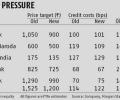
Banking stocks, including top ones like State Bank of India, ICICI Bank, HDFC Bank, Bank of Baroda and Bank of India, among others, have fallen sharply in the last one month.

'Investors with higher risk appetite and longer horizon (more than one year) can invest in longer-duration funds like corporate bond funds, long-duration funds and gilt funds for maximum gain.'

Recent rates cuts by most banks may not have a significant impact on margins, say analysts.

Every banker loves the four-letter word Casa as it plays an important role in lowering the cost of deposits. Every bank wants to increase its Casa, as a higher portion of Casa in the overall deposit liability brings down its cost of money, points out Tamal Bandyopadhyay.

But what do banks gain by opening their apps for all? The answer -- rival bank's customers under their fold.

With the Nifty50 just about 3 per cent away from its all-time closing high of 18,812 points, analysts at BofA Securities suggest investors book profit. Their reasons for the advice include risks like the possibility of a cut in corporate earnings growth forecasts, high valuation (one-year forward P/E of 19.5x), interest rates staying elevated for longer-than-expected and credit tightening. Going ahead, they expect the Nifty50 index to drop to 16,000 levels - down nearly 12 per cent from the current level of 18,255 points, which they believe would be a good time to buy.

Axis Bank and ICICI Bank consumed 37-59 per cent of their operating profit for COVID-19 provisioning, while the figure is 24 per cent in case of Kotak Mahindra Bank and 10-12 per cent for IndusInd Bank and HDFC Bank.

S&P Global Ratings on Thursday said about half of the Indian companies that it rates are getting a boost in their core profitability from rupee depreciation. "Much of our rated India corporate portfolio has sizable US-dollar linked revenue and, therefore, is not exposed to rupee depreciation. "This encompasses entities in the IT, metals, and chemicals sectors. About half of the firms we rate are getting an EBITDA boost from currency weakening," the US-based rating agency said in a report.

Corporate India is busy restructuring - through mergers, demergers and splits. That seems to be the new normal as CXOs and boards brainstorm on how to create assets and value. The pitch rose significantly during the third quarter of this financial year (FY24), translating into $32.9-billion worth of such deals - the highest quarterly total since the HDFC Bank-HDFC merger announced in FY22 Q2.

'Because it is the only public sector company in this sector, currently.'

India will drive growth in the Asia-Pacific (Apac) region as the growth engine is likely to shift from China to South and Southeast Asia in the coming years, S&P Global Ratings said in a report on Tuesday. The rating agency's report projected China's growth to slow down to 4.6 per cent by 2026 from an estimated 5.4 per cent in 2023. India is likely to clock 7 per cent economic growth from 6.4 per cent estimated for 2023.

The most preferred CoCo bonds are those through which banks raise their additional Tier-I capital.

Banks' loans are set to grow at the slowest pace in a decade this financial year, as companies continue to shy away from borrowing in the current uncertain macro-economic environment.

Small and medium enterprises have been struggling to raise bank credit even as they have been powering India's manufacturing growth in recent years.

Governor Raghuram Rajan's move to cut the MSF rate, at which banks borrow if they exceed their repo borrowing limits, by 0.50 per cent to 9 per cent should not be construed as a reversal in his policy stance and is more of a normalising measure, Citi said in a note.

The economic growth is likely to moderate to 6.1 per cent, slowest in over seven quarters, from 6.6 per cent last year same period.

The sharp correction in the Indian markets from their peak levels has made valuations attractive, say analysts, who advise buying selectively, but only from a long-term perspective. Fifty-six of the Nifty 100 stocks, according to Mahesh Nandurkar, managing director at Jefferies, now trade below the 10-year historical averages, including stocks in financial, select auto, and pharma sectors. "Valuation (one-year forward consensus price-to-earnings, PE) has declined 25 per cent from October 2021 peak, almost matching the 33 per cent price-earnings contraction during the 2011 tightening cycle when repo rates went up by 375 basis points (bps) versus 250 bps this cycle.

In the new decade, the scene will change because the banks till recently had been challenged by the fintechs, but the techfins have now entered the arena, observes Tamal Bandyopadhyay.

Barclays is not alone in trying to decide the best size and shape of its investment bank in a changed regulatory landscape.

With a loan book of $268 billion, India's retail banking is now ahead of Russia, Malaysia and Mexico but behind China, Brazil and Thailand

The continuing stress faced by corporate India has weakened their debt-servicing capability and this is reflected in the banks' books, as yet-burgeoning bad loans.

The growth in personal loans for fintech major Paytm may remain muted in the future and not replicate a three-digit year-on-year (Y-o-Y) growth that it recorded in the previous years, a person familiar with the matter said. Sources said the personal loans book may grow in the range of 30 to 40 per cent Y-o-Y on its current base. On a quarter-on-quarter (Q-o-Q) basis, the number of personal loans the Noida-based fintech company disbursed has dropped 20 per cent from 0.3 million in the first quarter of this financial year (Q1FY24) to 0.24 million in Q2FY24, according to regulatory filings.

'Investors should not commit fresh money to these stocks right now, unless they can hold for the next three to four years.'

The governor made it clear that the RBI is aware of what's happening and acts accordingly, but doesn't make a noise about that, points out Tamal Bandyopadhyay.
The One97 Communications stock saw a surge in interest as the company's operating performance update for August was considered positive by the Street. In addition, there was a news buzz as the company released a new hitech soundbox, which has longer battery life and processes all major cards. The performance indicates that the company, which is better known by its Paytm brandname, is still on course to achieve its guidance of going cashflow positive by the end of the 2023-24 financial year (FY24).

P2P platforms do not have the safety net. Instead of playing the role of an intermediary, if they run their own balance sheets for safety and growth, it's a recipe for disaster, warns Tamal Bandyopadhyay.

Among Sensex shares, Bajaj Finserv fell the most by 4.08 per cent. Bajaj Finance declined by 3.01 per cent, Tata Steel by 2.2 per cent, Wipro by 2.09 per cent, Tata Motors by 1.96 per cent, IndusInd Bank by 1.9 per cent, SBI by 1.75 per cent, Tech Mahindra by 1.66 per cent and HCL Tech by 1.2 per cent. TCS, Infosys, Power Grid, Maruti, Reliance, HDFC twins, L&T, M&M, NTPC and Ultratech Cement were also among the losers.

Though Indian banks don't have large exposure to subprime mortgages, analysts are worried at the rise in their restructured loan portfolios and deterioration in credit quality.

Though most experts remain bullish on the banking space, they suggest investors buy only those banks whose NPAs are at a manageable level of 3% to 4% and there is credit growth or earnings visibility.
 © 2026 Rediff.com - Advertise with us - Disclaimer - Privacy Policy - Sitemap - Feedback - About us - Terms of use - Grievances